Family history written from the sources
Every fact carries its archive reference.
We trace ancestors in parish registers, census lists and nobility files. You receive the result as a wall chart, a family chronicle and a recording to listen to. Next to every fact stands the document it comes from.
A proof in three parts
This is how a single fact appears in a chronicle: a clipping of the document, the text in its original language and a translation. The archive reference stands below, so anyone can open the same scan in the archive and check both the finding and the conclusion.

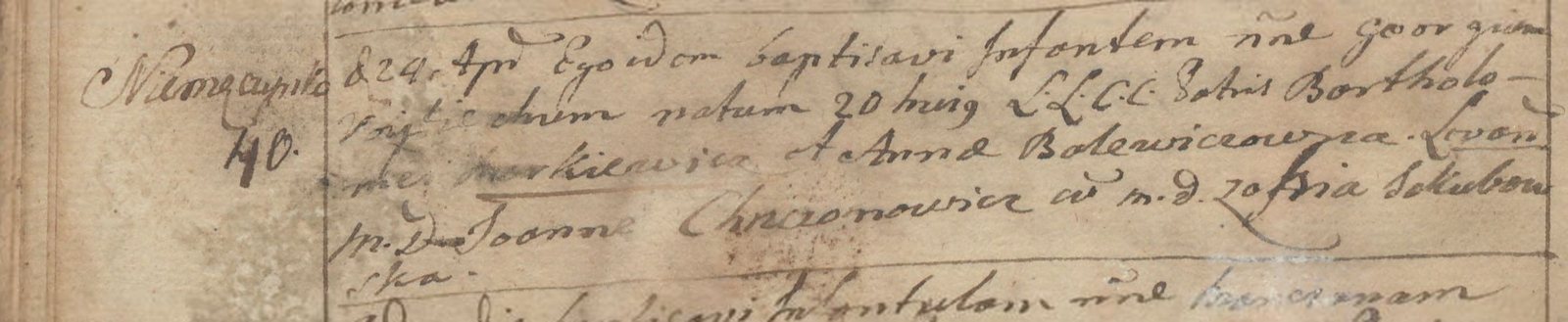
Aprilis d 12. 1785. […] Niemczynka. 40. d 24. Apr. Ego idem baptisavi Infantem nne Georgium Woyciechum natum 20 huius LLCC Patris Bartholomei Morkiewicz et Anne Bolewiczowna. Levan. M.D. Joanne Chrzczonowicz cu M.D. Zofia Sekulowska[?].
Heading: 12 April 1785. Village of Niemenczynka. Entry 40. On 24 April I, the same priest, baptised a child named Jerzy Wojciech, born on the 20th of this month, son of the lawfully married Bartłomiej Markowicz and Anna Baniewiczówna (the priest spelled the surnames Morkiewicz and Bolewiczowna). The godparents were the honourable Jan Chrzczonowicz and the honourable Zofia Sekułowska (surname uncertain).
This record comes from the showcase edition, the chapter “The Markowicz and Trabuć families” from the author's own family. The chapter has 55 figures and 21 notes. Where a reading is uncertain we say so plainly, as with the godmother's surname here.
What stays in the family
Family tree wall chart
The family tree to hang on a wall, in sizes up to A0. You receive a print-ready file.
Family chronicle
A book about the family, generation by generation. Each fact comes with a clipping of the record, the original text and a translation. A print-ready file plus an editable file.
Recording of the chronicle
The chronicle read aloud, to listen to on a phone. For those in the family who prefer listening to reading.
We work with sources in Latin, Polish, Russian and German. We know best the Vilnius region (the former Święciany and Vilnius districts, today in Lithuania and Belarus), Kashubia, Dobrzyń Land and the Lublin region.
Stages and prices
The work goes in stages. After each stage you receive a report and you decide whether we go on.
| Stage | What you get | Price |
|---|---|---|
| First assessment | You tell us what you know about the family: surnames, places, approximate dates. We reply in a few sentences whether registers for your parishes survive and whether the Start stage is realistic. | free |
| Start | A written list of the sources for your parishes. A tree back to your great-grandparents with records and translations. A wall chart ready to print. | 499 USD |
| Dig deeper | Further blocks of work, each covering 500 register pages read. A report after each block: what was found, what was checked with no result, what the next block is likely to bring. The chart, the chronicle and the recording are updated after each block. | 210 USD per block |
| Chronicle | The family chronicle built from the research: a print-ready PDF and an editable file. One round of your corrections and additions is included. | 499 USD |
| Recording | The chronicle read aloud, to listen to on a phone. After a round of corrections we record it again. | 159 USD |
| Further changes | Each further round of changes at your request, with a new recording. A round is one list of changes sent in one message. Our own mistakes are always corrected free of charge. | 79 USD per round |
A block is charged whether or not it brings a new generation. Prices are the same for every client, in Poland and abroad. They are set in Polish zloty and shown here in US dollars at a rounded rate. The chart and the chronicle come in English or in Polish at the same price.
Honest about results
The further back we go, the more registers are lost and the more often the answer is “not in this source”. That is still a result: it closes a lead and saves the next spend.
- We do not promise a number of generations, because that depends on which registers survived. We promise what depends on us: every fact will have a source.
- We do not assign coats of arms by surname. Nobility goes into your tree only when a document links your family to a proof of nobility.
- An age stated in a record is treated as an approximation, not as a date of birth.
Tell us where the family comes from
Send what you already know: surnames, places, approximate dates and the documents you have at home. A few sentences are enough. We will reply with which sources exist and where it makes sense to begin.
info@exarchivis.comThe first assessment is free. We reply in English and in Polish.